




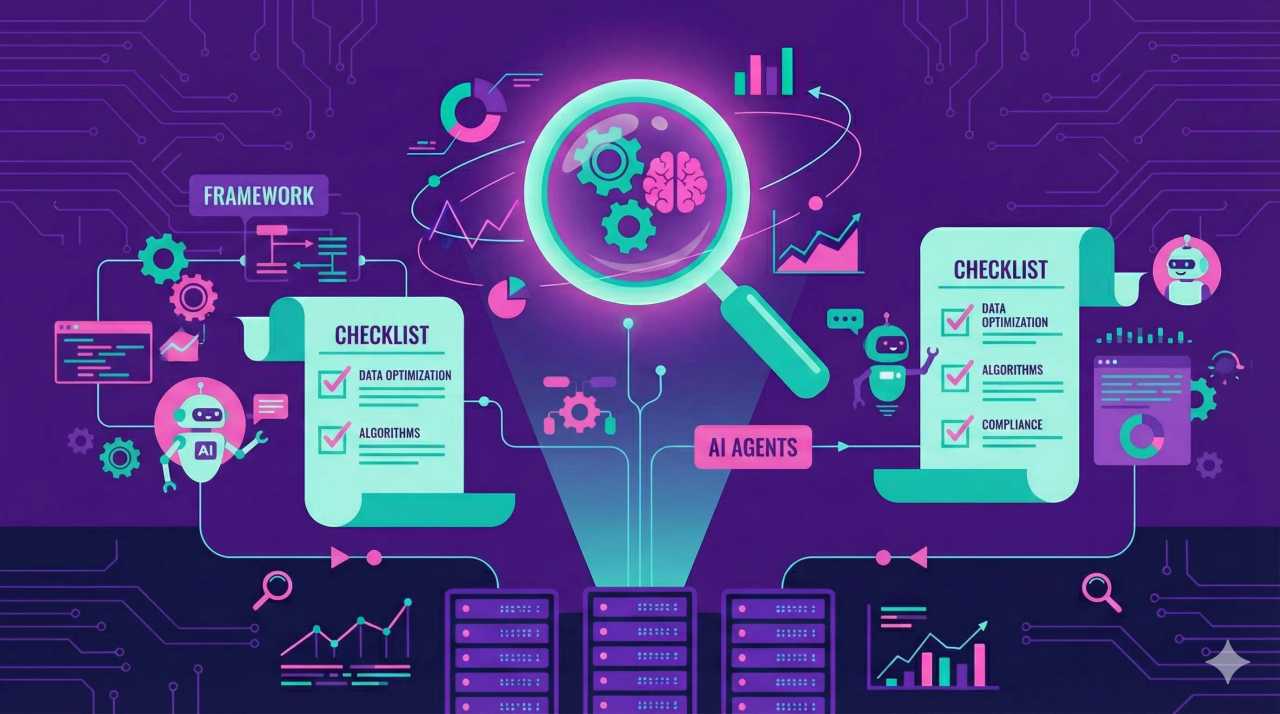
AI agents now research, summarize, and act across the web.
You need agents that accelerate your SEO work and a site that external agents can parse, trust, and recommend.
This guide gives you architecture, playbooks, governance, and metrics so you win in an agent-first search world.
Two dimensions of AI agents in search
Agents for SEO: internal workflows that automate research, briefs, QA, and monitoring.
SEO for agents: structuring your site, schema, and APIs so external agents cite you, send traffic, or trigger actions.
Treat both as part of the Future of Search pillar: Future of Search: AISO Playbook for Measurable Growth
Why act now
Personal and enterprise agents will fetch answers before users see blue links. If your content is not legible to them, you lose exposure and revenue.
Internal teams waste time on repeat tasks. Agents that follow guardrails can reclaim hours without risking brand safety.
Governance and compliance expectations are rising. Clear RACI and logging keep you audit-ready and fast.
Agent-first legibility model
Discoverability: clean information architecture, sitemaps, and internal links around entities.
Structure: rich JSON-LD (Organization, Person, Product/Service, FAQ, HowTo, LocalBusiness) aligned with visible text.
Verifiability: sources, dates, reviewer names, and policy links that agents can cite.
Actionability: clear CTAs, booking links, APIs, and documentation endpoints.
Performance: fast, stable pages that load without blockers for headless browsers.
Architecture for agents for SEO
Retrieval layer: store approved facts, URLs, and schema snippets for agents to use as context.
Tools: connectors for Search Console, analytics, log files, and AI detection feeds.
Policies: guardrails that define what agents can change and what needs human approval.
Observability: logs for prompts, actions, outcomes, and errors.
Review loop: humans approve meta, schema, and copy before shipping.
Key use cases: agents for SEO
Keyword and intent clustering with outputs mapped to briefs.
AI Overview and assistant citation monitoring with weekly snapshots.
Internal linking suggestions tied to entity clusters.
Schema validation and recommendations.
Content QA: fact checks, E-E-A-T signals, and tone consistency.
Performance checks: render blockers, CWV hints, and mobile UX warnings.
Key use cases: SEO for external agents
Expose accurate organization, product, and pricing data via structured pages and, when safe, APIs.
Publish clear FAQs, terms, and policy pages that agents can cite.
Use consistent identifiers for products and services so agents avoid ambiguity.
Provide short, answer-first intros and summaries that agents can lift with attribution.
Localize content and schema so agents serve correct answers per market.
Playbook: build your first SEO agent
Pick one workflow (weekly AI Overview checks). Define inputs, outputs, and success metrics.
Build a retrieval file with brand facts, URLs, and schema standards.
Write prompts with refusal rules, source requirements, and structured outputs.
Give the agent read-only access to analytics and detection scripts. No production writes.
Log every run with date, queries, results, and issues.
Review outputs weekly. Promote to more workflows after two clean sprints.
Playbook: make your site agent-readable
Map critical pages: home, products/services, pricing, documentation, support, and top guides.
Add or refresh JSON-LD for Organization, Product/Service, FAQPage, HowTo, and LocalBusiness where relevant.
Link to authoritative sources and include dates and reviewer names.
Provide API or data endpoints where safe for pricing, specs, or availability.
Add clear CTAs near summaries so assistant browsers can convert quickly.
Monitor AI crawler analytics to ensure GPTBot, Google-Extended, and PerplexityBot reach priority URLs.
Metrics to track
Internal agent metrics: time saved, tasks completed, accuracy rate, and error volume.
External visibility: inclusion and citation share in AI assistants, snippet accuracy, and crawl coverage.
Traffic and revenue: AI-driven sessions, assisted conversions, and revenue from cited pages or agent referrals.
Operational health: approval turnaround time, backlog size, and incident counts.
Governance and RACI
Assign owners for prompts, context files, and approvals.
Set permission scopes. Agents read data and draft changes, and humans approve and deploy.
Keep a change log of prompts, context updates, and shipped outputs.
Run monthly reviews with SEO, product, data, and compliance to adjust guardrails.
Add rollback steps for any automated change that affects live pages.
Compliance and risk controls
Avoid PII in prompts and logs. Use DLP where possible.
Tag high-risk workflows (health, finance, employment). Require expert review and disclosures.
Document how agents decide or suggest changes. Keep audit trails for the EU AI Act and GDPR.
For external agent legibility, avoid exposing sensitive data in schema or APIs.
Publish an AI use page that explains how you use agents and how users can request changes.
Content patterns agents love
Answer-first intros that use the main entity and one proof point.
Short lists or steps with verbs and outcomes.
FAQ blocks that mirror common prompts.
Sources and dates inside the copy.
Internal links from cited sections to conversion pages.
Agent-friendly technical hygiene
Fast LCP and stable CLS. Remove render-blocking scripts above the fold.
Clean HTML and predictable layouts so headless browsers can parse content.
Stable anchor links to key sections so agents can deep link users.
Compression and lazy loading for images, with descriptive alt text.
Internationalization: hreflang, localized schema fields, and language tags.
30-60-90 roadmap
Days 1-30: pick one internal agent workflow, build the context file, and launch with logging. Audit top pages for agent legibility and fix Organization/Person schema.
Days 31-60: add AI detection monitoring to the agent. Ship content and schema updates on five pages with answer-first patterns. Start tracking citations and AI-driven sessions.
Days 61-90: expand to additional workflows (internal links, schema QA), localize top pages for PT and FR, and set up dashboards for leadership.
Dashboards to build
Executive view: inclusion rate in AI assistants, citation share vs competitors, revenue influenced by cited pages.
Operations view: agent runs, issues found, actions taken, and approval times.
Technical view: crawl coverage by AI bots, schema validation status, and performance scores.
Compliance view: high-risk workflows, open approvals, and data retention timers.
Case scenarios
B2B SaaS: A security platform used an agent to monitor AI Overviews and suggest intro tweaks. After five weeks, citations appeared for “SOC 2 steps,” and demo requests from cited pages rose double digits.
Ecommerce: A retailer exposed clean Product schema and FAQPage blocks. Perplexity began citing the category hub, and add-to-cart rate improved on assistant-driven sessions.
Local services: A plumber added LocalBusiness schema, answer-first service pages, and allowed GPTBot while blocking training bots not aligned with policy. AI Overviews started citing the brand, and calls climbed.
Common mistakes and fixes
Agents with too much autonomy. Fix by restricting permissions and adding approvals.
Vague prompts that lack facts. Fix by feeding context files and URLs.
Ignoring monitoring. Fix by running weekly detection and logging results.
Over-focusing on one assistant. Fix by tracking Perplexity, Gemini, Copilot, and AI Overviews together.
Skipping compliance. Fix by masking PII, adding disclosures, and keeping audit trails.
Backlog template for agent-first SEO
Item description and target metric (inclusion, time saved, revenue).
Owner and due date.
Risk level and required approvals.
Dependencies (data, schema, performance fixes).
Expected impact and review date.
Team training tips
Teach teams when to use which prompts and how to provide facts.
Run tabletop exercises for incidents like wrong meta titles or hallucinated claims.
Share quick wins to build confidence. Measure cycle time improvements.
Rotate reviewers so knowledge spreads beyond one person.
How to evaluate tools and platforms
Coverage of needed bots and data sources.
Export and API access for logs and dashboards.
Permission controls, audit logs, and compliance posture.
Cost transparency and support responsiveness.
Integration ease with your CMS, data warehouse, and alerting.
Analytics stack for agents
Logging: store prompt, context version, timestamp, and outputs for each agent run. Mask sensitive data.
Detection: capture AI Overview and assistant citations weekly for tracked queries and tie to URLs.
Crawls: monitor AI bot hits and recency for priority pages. Link to visibility changes.
Web analytics: segment AI-driven sessions and assisted conversions from cited pages or agent referrals.
BI: build dashboards that combine agent performance, AI visibility, and revenue influence. Share weekly.
Agent-to-agent search readiness
Publish machine-friendly summaries with clear source citations so external agents trust you.
Provide structured endpoints for pricing, specs, support hours, and SLAs where safe.
Maintain up-to-date policy and FAQ pages so agents can answer user objections without guessing.
Keep brand terminology consistent across all languages to reduce ambiguity when agents compare vendors.
Add contact and booking hooks that agents can trigger, such as prefilled forms or deep links.
Vertical notes
Healthcare: require licensed reviewer approval for every change. Add disclaimers and authoritative references. Log all prompts and outputs.
Finance: keep rates and terms current with clear dates. Avoid speculative language. Use structured tables and sources that agents can verify.
Education: include curriculum details, accreditation, and outcomes. Add FAQPage schema for admissions and pricing questions.
Enterprise SaaS: highlight security, compliance, and integration steps. Expose API docs and changelogs with dates.
KPIs and targets by maturity
Starter: time saved per task, inclusion rate for top 50 queries, citation share vs top three competitors.
Scaling: AI-driven sessions, assisted conversions, snippet accuracy, crawl recency on priority URLs.
Advanced: revenue influenced by AI citations, agent-driven backlog burn-down, and time-to-recover after citation drops.
Incident response plan
Detect: alert on citation drops, blocked AI bots, or agent output errors.
Diagnose: check recent releases, prompt changes, and WAF or robots updates.
Act: roll back risky prompts, refresh content, and fix access rules. Document actions.
Review: log the incident with owner and next review date. Update guardrails to prevent repeats.
Training and change management
Create short videos showing how to use agents and where to find context files.
Run monthly clinics where teams review outputs, approve improvements, and retire weak prompts.
Share success stories with metrics to build adoption. Highlight one guardrail win each week.
Keep onboarding packs for new hires with links to the prompt library, SOPs, and dashboards.
Budgeting for agent programs
Estimate time saved and revenue influence to justify investment. Track both monthly.
Start with free or low-cost tools plus custom scripts, then upgrade once workflows prove value.
Allocate budget for compliance reviews and expert approvals in regulated sectors.
Set aside time for maintenance: prompt updates, context refreshes, and dashboard care.
Roadmap alignment with product and PR
Sync content releases with product launches. Update agents with new facts before shipping pages.
When PR earns links, refresh agent context and cited pages to include the new proof points.
Coordinate messaging across ads, landing pages, and AI summaries so agents repeat consistent claims.
How AISO Hub can help
AISO Audit: maps your agent opportunities, legibility gaps, and governance needs, then delivers a prioritized roadmap
AISO Foundation: builds your agent context, prompt library, logging, and dashboards so teams can run safely and fast
AISO Optimize: upgrades content, schema, and UX for agent readability while deploying internal agents that find and fix issues
AISO Monitor: tracks AI assistants, crawlers, and agent outputs weekly with alerts and exec-ready reports
Conclusion
AI agents are reshaping search.
When you deploy agents for your workflows and make your site legible to external agents, you gain speed, visibility, and revenue.
Use this framework to design architecture, guardrails, prompts, and dashboards that keep you in control.
If you want a partner to build and run this system, AISO Hub is ready.